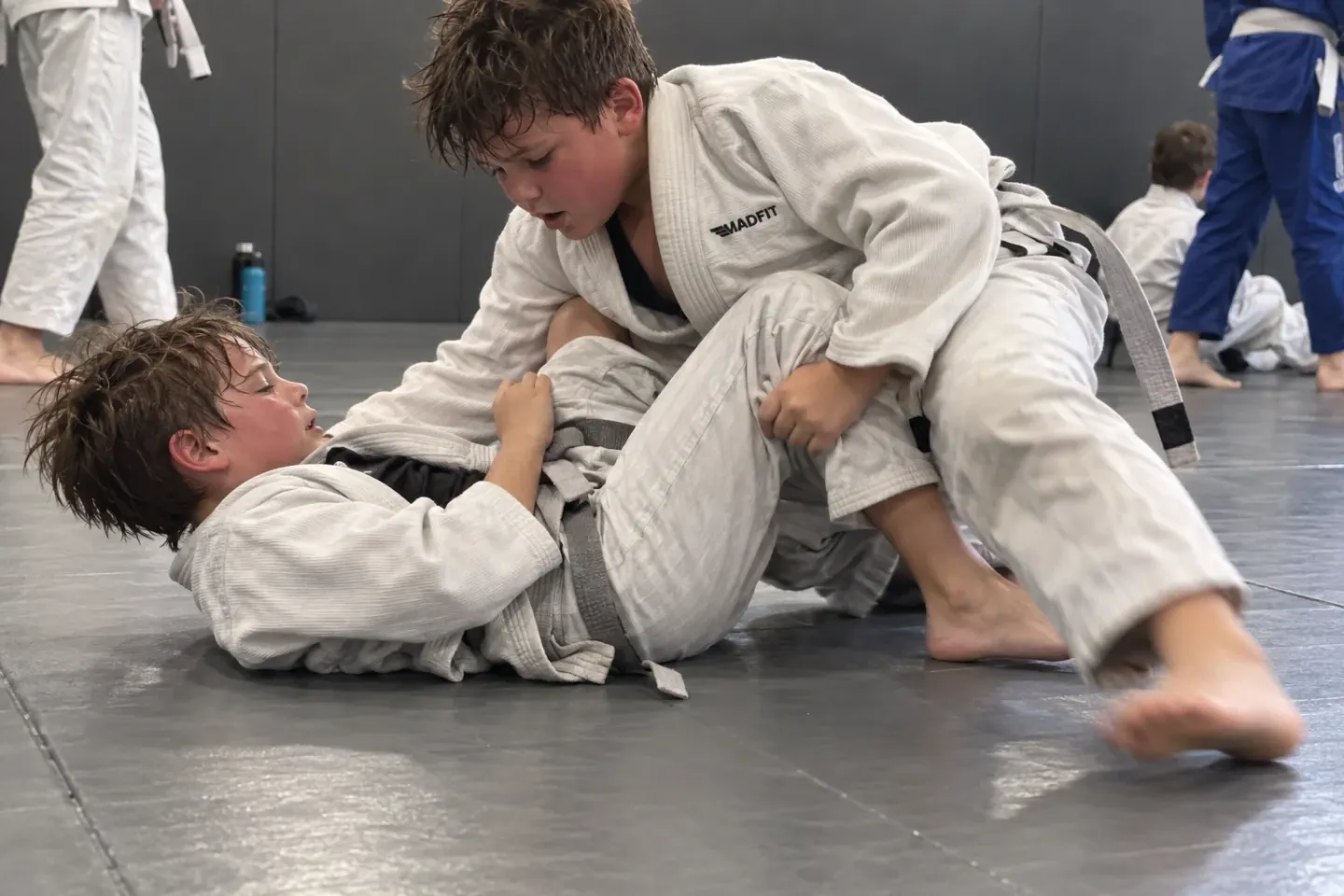
In April this year, two months after my son was born, I started coaching the kids' class at my Brazilian Jiu-Jitsu gym, MADfit MMA in Cape Town.
I graded to blue belt under Don Madge in 2025, which in Jiu-Jitsu terms makes me a beginner who has stopped being a complete beginner. Teaching has always been the thing I care most about (it is why I work in education), so being handed a mat full of children was a gift. It has also been humbling in a way I did not expect. To teach a side control escape to a child, you have to understand a side control escape far better than you need to in order to do one. I have gone back to the fundamentals, studied them properly, and my own Jiu-Jitsu is better for it.
Something I keep noticing: the kids who train regularly seem to get better at focusing, staying on a task, solving a problem while someone is sitting on them, calming themselves down when it goes wrong, and cooperating with a partner. Other coaches say the same. So do the other parents, and so do the teachers and educators I know who have kids on the mat. So I went and read what the peer-reviewed research says, and this article is what I found.
Before I start: almost all of the research on children was done with boys, and most of the children who walk into our gym are boys, so this article is about boys and young men. Girls get most of the same benefits, but the research itself is almost entirely on boys.
Why has anyone researched this at all?
Martial arts and children have been studied since the 1980s, mostly in karate, taekwondo and judo, because those sports were in schools and community programmes long before Jiu-Jitsu was. The question researchers kept asking was simple: if you teach a child to fight, does he become calmer or more aggressive?
Brazilian Jiu-Jitsu is different from those sports in one important way. There is no striking. You win by controlling your partner on the ground and getting them into a position where they tap (a hand tap that means "stop, you got me"). Nobody gets hit. That difference matters for the research, because a lot of what was found in karate and taekwondo may or may not carry over.
The Jiu-Jitsu-specific research is young and small. Most of it exists because of one place: Abu Dhabi, where the government put Jiu-Jitsu into public schools in 2008 and grew it to well over a hundred schools. That gave researchers something they almost never get in martial arts: whole classes of ordinary schoolboys doing the same programme, with normal Physical Education classes next door to compare against.
So when I say "the research", I mean a handful of Jiu-Jitsu studies, nearly all from Abu Dhabi, sitting on top of a much bigger pile of studies on other martial arts. I will tell you which is which.
What the research does support
Focus and classroom behaviour: the best study we have
The strongest piece of evidence is a randomised trial published in 2022 by Bueno, Andreato and colleagues in the International Journal of Sport and Exercise Psychology. "Randomised" is the word that matters. Eighty-eight Grade 6 boys, roughly 11 years old, were split by chance into two groups. One did 12 weeks of Jiu-Jitsu at school. The other did their normal PE. Because the split was random, you cannot explain the result by saying the calmer boys chose Jiu-Jitsu.
Their teachers, who scored the boys' behaviour before and after, reported that the Jiu-Jitsu group came out with lower emotional symptoms, lower hyperactivity and inattention, and fewer "externalising" problems. Externalising is the researchers' word for acting out: disruption, defiance, the stuff that gets a boy sent out of class. The effects were small to moderate, so not a transformation, but a real and measurable shift inside one school term.
That is the study I would point any sceptical parent to. It is also one study, in one city, with boys of one age, over one school term, and nobody has yet repeated it somewhere else. I would love to see it run in a South African school.
Stopping yourself: inhibitory control
An earlier study from the same Abu Dhabi programme followed 59 boys aged 10 to 12 over six months and tested what psychologists call inhibitory control (the ability to stop yourself doing the first thing that pops into your head). It is the skill a boy uses when he does not shout out the answer, does not shove the kid who bumped him, and does not abandon a maths problem the moment it gets hard.
The boys who attended more Jiu-Jitsu sessions did better on the test. This one was not randomised, only followed 59 boys, and was published as a two-page conference abstract rather than a full paper, so I hold it more loosely than the first study. But the direction is the same, and it fits what you see on the mat. Jiu-Jitsu punishes the impulsive move straight away. Lunge for the arm and you get swept, panic under pressure and you get choked, and the boy learns with his own body that patience works.
Self-control and being decent to other people
A Swedish study from 2020 followed 113 young people over five months, some training Jiu-Jitsu and some training MMA (mixed martial arts, which includes striking). Both groups improved in self-control and in what the study called prosocial behaviour, which just means being helpful and considerate towards others. Aggression went down in the Jiu-Jitsu group and up in the MMA group.
The MMA group started out more aggressive, which is a fair warning that the kind of boy who picks a sport is not random. But the finding that Jiu-Jitsu trainees became less aggressive over five months, not more, is the best answer we have to the question every parent asks first.
The wider martial arts evidence
If you widen the lens to other martial arts, the picture is fuller. A 2004 American study put 207 primary school children through three months of taekwondo at school, against a normal PE group. The taekwondo children improved more on self-regulation, classroom conduct and, interestingly, on a mental arithmetic test, with the boys improving more than the girls. A 2011 review in the journal Science, looking at what actually improves executive function in children (planning, focus, self-control), listed traditional martial arts among the things that work. The reviewers' explanation was that the activities that help all share one feature: repeated practice with steadily rising challenge, which is a decent description of any good Jiu-Jitsu class.
The physical side
This part is the least controversial. Two recent reviews, one of judo on its own and one across karate, judo, taekwondo and aikido, cover children and young teenagers from about 4 to 15 and find gains in balance, coordination, agility and explosive strength in most of the studies they looked at. One 2024 study followed 182 children aged 4 to 7 doing judo for six months and found real improvements on clinician-run tests of movement development. A detail from that study stuck with me: the parents' own ratings did not track the clinical measurements. Parents did not notice what the clinicians measured. Keep that in mind when you are judging whether a sport is "working" for your son from the sidelines.
None of that physical research was done on Jiu-Jitsu specifically. But falling practice, base and posture, and pushing against a resisting partner are the same ingredients, so I am comfortable extrapolating.
The thing you cannot fake
There is a benefit of Jiu-Jitsu that no study has measured, and I think it may be the most important one for a boy's education.
Jiu-Jitsu can be practised at full resistance. Your partner is genuinely trying to stop you, every round, so there is nowhere to hide. In most sports, and in most classrooms, a confident manner buys you something. On the mat it buys you nothing. The boy who talks the biggest game on the playground gets tapped by the quiet kid who drilled his escapes, everyone saw it happen, and there is no argument to be had about it. Not being able to do the thing shows in seconds and cannot be explained away.
I have watched grown men who are confident in every other part of their lives get quietly taken apart by a purple belt half their size, and walk off the mat laughing about it. Whatever ego you carry in, the mat takes it off you, and it does the same to a ten-year-old. That is where the humility comes from. It is not taught as a value. It is just what happens when you are measured honestly, over and over, by something that does not care how you feel about yourself.
What I find valuable about this for children is that so few places in a boy's life work like that. On the mat, the feedback is immediate, honest, and completely indifferent to your opinion of yourself, and the only way through it is to develop real skill, built slowly and with intention. That is a rare and useful thing for a young man to learn early. My own son was born in February this year, and part of why I took on the kids' class was to find out whether I would want this for him. I would.
What the research does not show
It does not show better marks, yet. Not one study links Jiu-Jitsu to school results. The evidence is about classroom behaviour and self-control, which are things that help a boy learn. That said, it would surprise me greatly if a proper study did not find an improvement in academic results.
The aggression question is genuinely unsettled. The Swedish study I mentioned is encouraging, but if you go back through the wider martial arts research, it points both ways. Two French studies of eight-year-old judo beginners found that the boys who chose judo were angrier to begin with, and a year later scored higher on aggression than their classmates, not lower. A two-year Norwegian study of 477 boys aged 11 to 13 found that "power sports" (boxing, wrestling, weightlifting and the traditional martial arts, pooled together) predicted an increase in antisocial behaviour. The most careful recent summary, a 2026 analysis that only counted randomised trials, found no significant effect of martial arts on aggression either way.
The study that makes sense of all this is an old one. In 1986 a researcher named Trulson took 34 delinquent teenagers and, for six months, taught one group traditional taekwondo, with its emphasis on self-control and respect, and another group the same fighting techniques without any of that (a third group just did ordinary exercise with the same instructor). The traditional group improved and the fighting-only group got more aggressive. The techniques were the same, and the coaching was the difference.
I believe that is the honest answer for Jiu-Jitsu too. Whether your son comes out calmer depends less on the sport and more on the person teaching it and the culture of the room, so make sure you choose a gym with a coach and a culture that understands this.
Confidence has not been measured in children. Adults who train describe gains in confidence and perseverance in interviews, and a 2025 survey of 420 adult practitioners found that self-control went with better mental health. But surveys of people who are still training cannot tell you whether Jiu-Jitsu built the self-control or whether self-controlled people are the ones who stick with it. There is no controlled study of confidence or self-esteem in children doing Jiu-Jitsu. The nearest thing is in other martial arts, and it points both ways: in Trulson's 1986 study above, the boys taught traditional taekwondo came out with higher self-esteem as well as lower aggression, while a 2021 study of at-risk teenage boys doing six months of karate, judo and ju-jitsu found no change in self-esteem at all. Even so - as with the marks - it is easy to imagine that confidence and self-control are improved by Jiu-Jitsu and that future studies will demonstrate that.
ADHD and autism: promising, thin. Small studies of other martial arts with children who have ADHD show improved attention and less impulsivity, and a few tiny adapted-judo studies show gains for autistic children. None of it is at scale, controlled, or about Jiu-Jitsu specifically.
Injuries, and what to look for in a gym
Jiu-Jitsu is called "the gentle art" and that is true relative to boxing. It is not true in any absolute sense.
The competition numbers for children are reassuring. A study of eight tournaments found about eight injuries per 1,000 matches in the divisions for children aged 15 and under (five injuries in all, so a small number), well below what similar studies report for judo, taekwondo, wrestling or MMA. For a sport most South African parents know, youth rugby studies report around 40 injuries per 1,000 hours of match play for boys. The units are different, so treat that as a rough sense of scale rather than a direct comparison, but it is not close. Training is where most injuries actually happen, though, and there the picture is less rosy. A 2025 analysis of American emergency departments found that visits for children's Jiu-Jitsu injuries rose roughly six-fold over ten years as the sport grew. Sprains and strains made up about 28% of those visits and fractures about 20%. The authors specifically flagged elbow dislocations from arm locks in children's classes. The average injured child was 11.
In adults, about a quarter of practitioners report having had at least one concussion from training, mostly from takedowns, falls and collisions rather than from being hit, and skin infections like ringworm and staph are the thing practitioners most often end up seeing a doctor about, partly because people worry about passing them on. Most injuries overall are the ordinary kind: fingers, toes and elbows.
With all of that in mind, here is what I would ask before signing a boy up:
- How do you teach them when not to use it? The research says the coaching philosophy is what decides the outcome.
- What happens when a child is caught? The right answer involves tapping early, letting go immediately, and treating a tap as intelligence rather than defeat. The coach should teach this by modelling it in their own rolls with the kids.
- Which submissions do you allow for kids? Every serious youth ruleset bans heel hooks, wrist locks, neck cranks and slams.
- How do you handle skin? Mats cleaned daily, no training with open lesions, kit washed after every session.
- Can I watch? A good gym will want you to.
A note on what this has to do with tutoring
What I see on the mat is the same thing our tutors see in session. A boy who can sit with being stuck and struggle through it instead of giving up. A boy who has learned that the honest feedback of getting something wrong is information, not an insult. A boy who can slow down and try the second idea instead of forcing the first. Jiu-Jitsu builds those things through the body, and the research above suggests it does so measurably. Good teaching builds the same things through the work.
If you want to talk about the desk half of that, you can book an assessment by heading over to our contact page, or reaching us on hello@geniuspremium.com, or +27 11 467 9884.
And if you want to talk about the mat half, book a trial class for your child at MADfit MMA.
Sources
The studies discussed above, for anyone who wants to read them:
- Bueno JCB, Andreato LV, Silva RB, Andrade A. Effects of a school-based Brazilian jiu-jitsu programme on mental health and classroom behaviour of children from Abu Dhabi: a randomised trial. International Journal of Sport and Exercise Psychology, 2022.
- Bueno JCB, Saavedra L. Brazilian Jiu-Jitsu and inhibitory control: effects of practice on secondary public school students in Abu Dhabi, UAE. Revista de Artes Marciales Asiáticas, 2016.
- Blomqvist Mickelsson T. Modern unexplored martial arts: what can mixed martial arts and Brazilian Jiu-Jitsu do for youth development? European Journal of Sport Science, 2020.
- Lakes KD, Hoyt WT. Promoting self-regulation through school-based martial arts training. Journal of Applied Developmental Psychology, 2004.
- Diamond A, Lee K. Interventions shown to aid executive function development in children 4 to 12 years old. Science, 2011.
- Trulson ME. Martial Arts Training: A Novel "Cure" for Juvenile Delinquency. Human Relations, 1986.
- Endresen IM, Olweus D. Participation in power sports and antisocial involvement in preadolescent and adolescent boys. Journal of Child Psychology and Psychiatry, 2005.
- Scoggin JF et al. Assessment of Injuries During Brazilian Jiu-Jitsu Competition. Orthopaedic Journal of Sports Medicine, 2014.
- Hasegawa ME et al. Increasing Trend in Pediatric Brazilian Jiu Jitsu Injuries Presenting to US Emergency Departments. Hawaii Journal of Health and Social Welfare, 2025.
- Spano M et al. Epidemiology of Sports Related Concussion in Brazilian Jiu-Jitsu. Sports, 2019.
- West SW et al. Injury Rates, Mechanisms, Risk Factors and Prevention Strategies in Youth Rugby Union: A Systematic Review and Meta-analysis. Sports Medicine, 2023.
- McDonald AR, Murdock FA, McDonald JA, Wolf CJ. Prevalence of Injuries during Brazilian Jiu-Jitsu Training. Sports, 2017.
- Harwood-Gross A et al. The Effect of Martial Arts Training on Cognitive and Psychological Functions in At-Risk Youths. Frontiers in Pediatrics, 2021.